What do you want to be when you grow up?

By Dr. Bruce Metcalf, CEO, Merced Rescue Mission

If you were to ask a room full of first graders what they want to be when they grow up, not one of them would answer, “I want to grow up to be homeless.” So, what are the root causes of homelessness? Let me share some of these causes with you.

UNDERSTANDING HOMELESSNESS - ROOT CAUSES OF HOMELESSNESS

Housing Shortage: During the past 50 years, growth in available housing units has not kept pace with population growth.

High Housing Costs: The cost of purchasing a home or renting has skyrocketed, which has priced many people out of the market.

Mental Health Issues: In the 1980’s mental health institutions were closed without a plan for alternative mental health care. Many people found themselves without a place to live and were forced into homelessness.

Broken Relationships: As a result of broken relationships, such as divorce or alienation from family, many people have found themselves homeless.

Loss of Employment: When people have lost jobs, they no longer have been able to make mortgage or rental payments.

Addiction Issues: Drug and alcohol abuse has caused people to lose jobs and relationships. In addition, the loss of jobs and broken relationships have themselves been a cause for people to use drugs and alcohol as they try to drown their pain and feelings of hopelessness.

These are some of the root causes of homelessness. The causes are diverse, and there are no simple answers. To successfully address the issue of homelessness and make positive headway towards solving this issue requires a collaborative effort between the government (local, state, and federal), the religious community, social agencies and organizations, and individuals experiencing homelessness. People experiencing homelessness must be included in the process of finding solutions because any solution personally affects them. The issue of homelessness will not go away by simply ignoring it. We must work together by investing time, money, and other resources.

Merced County is working hard to address the issue of homelessness. The County and cities within the County have joined forces with churches, social organizations, and people experiencing homelessness to make a difference. Together we are on course to reduce the number of unsheltered people experiencing homelessness by more than half in the next two years. Within four years we are hoping to reach a Net Zero* of people experiencing homelessness.

*Net Zero is achieved when there is enough housing for every person experiencing homelessness. As new people become homeless, programs already in place will help in moving them toward housing.

Click here to learn about our programs at the Mission.

Hydration Essential in Hot Weather

During the heat waves that we have been experiencing, we are all aware of how important it is to stay hydrated. For people living on the streets without access to air-conditioning, it is critical that they have water. Water is distributed every day as our staff goes out into the community to meet with people who are unhoused. Recently, Interact students from the high school chapter of Rotary helped distribute water to people who were in desperate need. Many thanks to all the Interact students who participated in this effort!

Challenge grant for potential Hope Respite Care Expansion

Hope Respite Care is a 32-bed facility for people experiencing homelessness when they are discharged from the hospital or referred by a medical facility for temporary housing during a period of recovery. Hope Respite Care has been operating at near capacity for some time. A person can receive services for up to 90 days based on approvals. Beyond that, while great efforts are made to help the person find permanent housing, housing is often unavailable, and some participants require extended post-hospitalization help.

To accommodate this need, many of the beds in Hope Respite Care have been used to provide extended stays. The result has been that beds are not always available for people when they are discharged from the hospital.

Central California Alliance for Health, our Medi-Cal provider, has offered a challenge grant of 2.5 million dollars towards a 5 million dollar building which would allow for expanded services and 20 studio apartments for permanent supportive housing. The Mission is now seeking funding sources to match this challenge grant.

Please keep this project in your prayers.

Judge Lo - Reflecting on the Homeless Court Program

In reflecting on the Homeless Court Program, Judge Lo writes the following to the people who take advantage of this life-changing new program.

MERCED COUNTY HOMELESS COURT PROGRAM

Hope is a good thing, maybe the best of things. And no good thing ever dies. (Shawshank Redemption) Here’s the question: Are you homeless but hopeful, or is the court hopeful but homeless? Both, actually.

First, let’s talk about you. Homelessness doesn’t have to lead to hopelessness. You may be homeless, that is, you do not yet have a place of your own, but the court wants to give you hope as you work toward having your own place. We can’t do everything, but we can clear financial and/or legal hurdles by recalling misdemeanor warrants and infraction failures to appear and forgiving or reducing related fines and fees. If your case meets criteria, the court will allow you to satisfy or reduce your fines and fees with volunteer or programming hours. For example, if you are in an outpatient treatment program or a residential treatment program (such as the Rescue Mission, the Hobie House, Tranquility Village, Iglesia De Cristo, and other such programs), your volunteer and programming hours would probably be more than enough to wipe clean or substantially reduce your qualified court fines and fees.

How can you take advantage of this service? The first thing you do is contact the court Homeless Court Navigator, Mr. Jim Romig, at (805) 975-3787. He can help walk you through the whole process, including helping you to complete the necessary forms, submitting them to the court, and appearing with you at your court hearing. You will also be represented by an attorney at the Public Defender’s Office or another attorney free of charge to you.

Second, let me explain the court’s hopeful but homeless situation. The court is homeless because you do not come to the courthouse for your hearing. We come to you, that is, the court comes to a community center to hold your hearing. We hope that by holding hearings away from the courthouse, you can be at ease that the court is there to help, not punish. We promise that you will not be arrested for an outstanding warrant for appearing at your Homeless Court hearing. Currently, our hearings are held on the 3rd Tuesday of the month, at 3pm, at the Village of Hope, 129 West Cone Avenue, Building 1.

“Remember Red. Hope is a good thing, maybe the best of things. And no good thing ever dies.” We will be hoping that you will take full advantage of this program.

- Judge Paul C. Lo, Merced Superior Court

Judge Paul C. Lo, Merced Superior Court

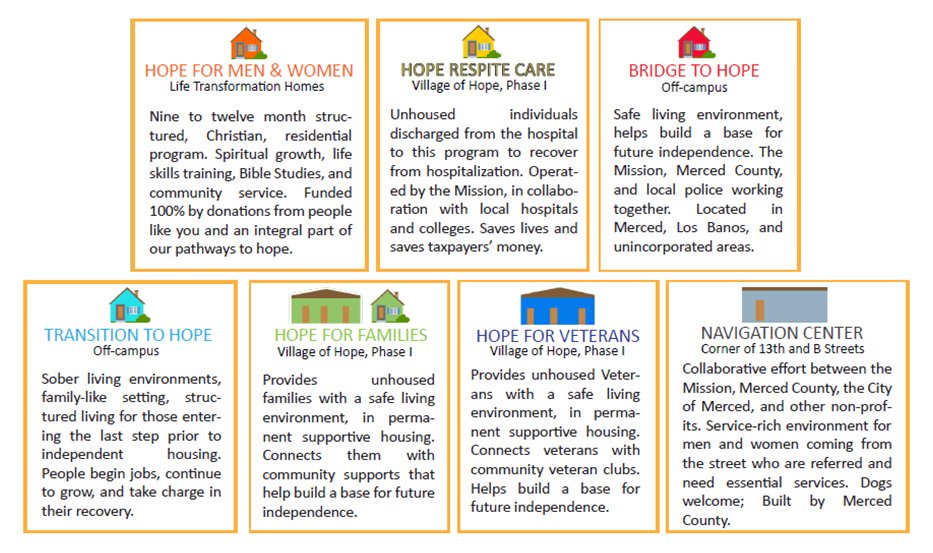
Pathways to Hope - What We Do

Pathways to HOPE take many routes. The illustration below shows a few examples. Our programs work together to help people who are hopeless find healing, housing, jobs, and life change.

Our faith-based Hope for Men and Women program is an integral part of our pathways to hope and is funded 100% by donations from the community. Give today!

Thank you for supporting the Mission, all donations are appreciate! We are grateful to partner with you!

One Step at a Time - A Trip To the Redwoods!

On Thursday, March 14th, 25 participants from the Hope for Men and Women program traveled to Felton, near Santa Cruz, to visit the redwoods in Henry Cowell State Park. God provided a beautiful day for us to enjoy His creation. The day was more than special because many of the men and women had never been to the coast and had never seen the redwoods. We walked together on paths through the majestic trees, taking in the beauty, and we spent time praying and meditating on God’s creation! We recognized how God has so incredibly shown Himself to us in nature and has uniquely created each one of us to be special and gifted for His purposes. What a great day!

Two New Programs - Access to Health and Housing

Advocates and Help - So People Don't Suffer on the Street

Both programs are generously funded through CalAIM, part of Medi-Cal.

ECM (ENHANCED CARE MANAGEMENT), OUTREACH PROGRAM

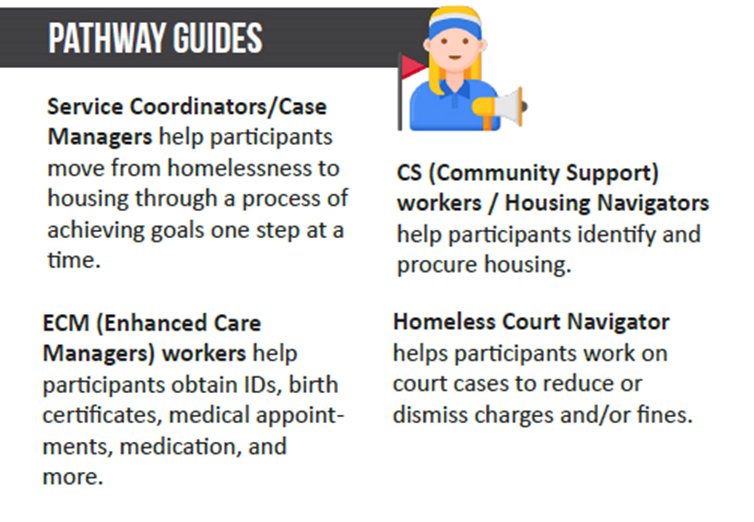
ECM is a new benefit for Medi-Cal members. This benefit helps Medi-Cal Alliance members who have complex needs coordinate their care with the help of ECM Outreach workers.

Mission Merced started providing ECM services in February of 2023 with only two Outreach workers and now we have eight Outreach workers. We are presently serving over 150 people.

ECM outreach workers help participants:

• Find doctors

• Schedule health-related appointments

• Manage medications

• Set up rides to the doctor or pharmacy

• And much more

To get ECM services from Mission Merced, call our office at 209.455.3716 to meet and apply with one of our ECM teams.

Enhanced Care Management Teams: Pat & Rose, Rafa & Cole, Summer & Teresa, and Tammy & Alexis.


Pat Padilla and Rose Guerra are one of the Mission’s five ECM teams. The following stories illustrate what ECM does for Merced County as it strives to help those experiencing homelessness receive the care they need.

A concerned community member contacted the Mission about a man who was cold and sleeping on the sidewalk. He appeared to be ill and in need of a place to recover. Pat and Rose picked him up and transported him to the Mission’s Hope Respite Care. He stayed there where he was able to recover in about three weeks.

Pat and Rose transported another man who was experiencing severe back pain to the hospital where he was able to receive help. Following treatment, Pat and Rose transported him to Hope Respite Care where he could continue to heal and be taken to physical therapy appointments.

Another day, they helped a woman who was struggling with mental health issues. They knew they needed to get her some help, so they took her to Behavioral Health and Recovery Services (BHRS) for an emergency assessment which determined that she needed to be taken immediately to the Crisis Center. They stayed with her to give her support. After she was taken in by the Crisis Center, they were able to keep in contact with her and talk with her. She is now released and is doing great. She is so very thankful for all the support and the quick response of the ECM team. Pat and Rose still talk often with her and are so glad to see the great turnaround in her life.


CS (COMMUNITY SUPPORT), PROVIDING HOUSING NAVIGATION

In August of 2023, the Mission started the Community Support program, which provides housing navigation. Our CS team of Housing Navigators work with over 80 clients at a time.

CS workers help participants:

• Find permanent housing

• Move into their new home

• Pay for application fees

• Pay for move-in costs

• Purchase basic household items

Our CS Housing Navigators help people who are experiencing homelessness see the light at the end of a dark tunnel. Through love, care, and attention to detail, our CS Housing Navigators bring hope to people who have been hopeless. Through this program, the Mission has been privileged to join in the county-wide collaborative effort to significantly reduce homelessness.

To get CS Housing services with Mission Merced Inc., call our office at 209.455.3716 to meet and apply with one of our Housing Navigators or call Alliance at 800.700.3874.

CS Team: Marissa and Liberty

Marissa and Liberty work as Community Support Housing Navigators. They work with people who have been homeless and who often feel helpless. As they work with people, they not only bring hope to the people they serve, but they also find joy through their serving and feel that doing this job could not be more rewarding.

Together they help many individuals with finding and moving into a home by paying for the application fees, move-in costs, and, with any money left over, basic household needs. One client was feeling down and didn’t have much hope when he came into the office for his intake. He was discouraged because of his situation. After completing his intake and having heard the program explained, he was feeling hopeful again.

Once this client found a place he could afford, the application fees, the deposit, and the first month’s rent were all paid. Then, Marissa and Liberty worked on his wish list of basic household items. He now has a place he can call home. To him, this was like winning the lottery.

Marissa and Liberty feel that seeing their clients’ happiness when they get to move in is more rewarding than they could ever put into words. Getting to watch God open so many doors to help their clients have a bed to sleep in, a table to eat at with dishes to eat on, and a couch on which to sit is amazing. Seeing their clients’ smiles and hearing the excitement in their voices is one of the best paydays anyone could ever receive.